

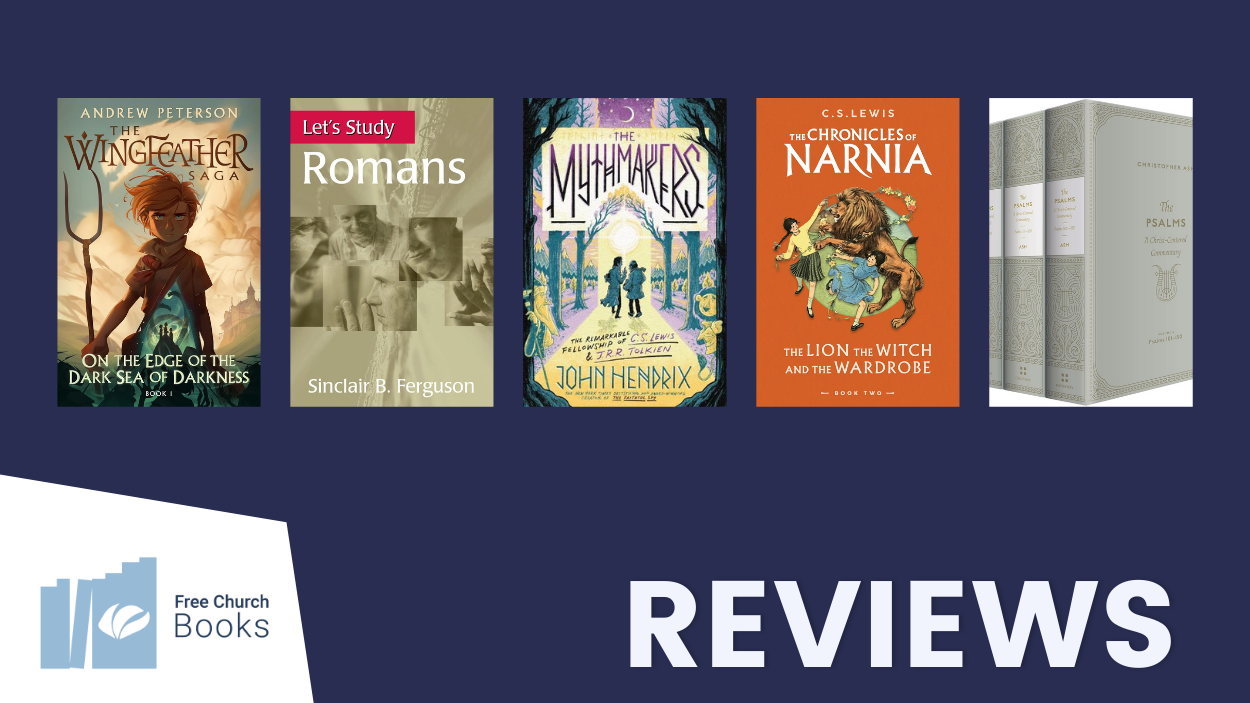
For our first set of book reviews to round off the year, we highlight the best in older children’s fiction, along with some excellent new Bible knowledge resources.
BOOK OF THE MONTH: ‘The Lion, The Witch and The Wardrobe’, C.S. Lewis (1950)

Why is the 75th anniversary of the publication of The Lion, the Witch and the Wardrobe the perfect time to read or re-read this perennial classic? A publishing executive would say that over one-hundred million happy customers can’t be wrong (N.B. 100 million people definitely can be wrong, but we’ll gloss over that for the moment); an English teacher (and I write as a former English teacher who has taught his book to hundreds of children) would tell you that C.S. Lewis writes with the precision of a scholar and the beauty of a poet; but here’s the real reason why you should read this text: no book will better baptise your imagination than The Lion, the Witch and the Wardrobe.
Do you want adventure? It has great battles and midnight escapes. Do you want heroes? It’s got King Peter, brave beavers and, of course, Aslan. Do you want vile villains? It had ogres, and hags and boggles (I’ve never been sure what boggles are, but I would prefer not to meet one on a dark night); it’s got secret police, talking wolves, and a White Witch. But beneath the surface action, it has a profound yet accessible understanding of heroism and courage, of the true nature of evil, and the true cost of redemption.
If pushed to name whom in my generation has had the greatest impact in turning the hearts of the British to their God, I would suggest C.S. Lewis. And that is also the reason why I am commending The Lion, the Witch and the Wardrobe to you.
Chris Stone, St Peter’s Free Church, Dundee
If you like C.S.Lewis, you should also try…

The Mythmakers, John Hendrix (2024): A hybrid text and gorgeous graphic exploration of the theology, friendship and writing of JRR Tolkien and C.S. Lewis, this meticulously researched and remarkably deep book points its reader to the Saviour these writers clung to above all.

The Wingfeather Saga, Andrew Peterson (2024): Epic adventures, humble heroes and compelling storytelling combine to make these stories modern classics in the same mould as Narnia and Middle Earth. The main characters are children, and one of the greatest strengths of this series is how these youngsters are presented as flawed, realistic kids – but ones whose trust in the Maker and ability to listen to the wise adults around them enables them to face challenge after challenge.
Let’s Study Romans, Sinclair Ferguson (2025)
“Let’s Study Romans” by Sinclair Ferguson is the latest book in the Banner of Truth’s “Let’s Study” series. The publisher explains in the Preface that the purpose of the series is to explain and apply the message of Scripture to ordinary Christian people.

We are reminded in the Author’s Preface of the importance of Romans: “No letter in history has had a greater influence on the fortunes of the Christian church”. He later explains that it is, in fact, the most important letter ever written. How significant it was in the conversions of Augustine, Martin Luther and John Wesley! How significant it should be for every Christian: “a doctrine-filled document that expounds the ‘gospel of God’; a pastoral document that addresses some very real problems that continue to trouble the church; and a missiological document expressing Paul’s burden to bring the gospel to places where it had never before been heard”.
After a helpful outline: Introduction; Salvation Needed; Salvation Provided; Salvation Experienced; Salvation for Jew and Gentile; Salvation in Daily Life, and Final Words, the book has 40 chapters, divided into sections. Each chapter begins with text from the Epistle which the author then explores and explains. The commentary consists of almost 400 pages. There then follows study guide material with questions on each section of the book designed to encourage personal thought or group discussion. This is a valuable addition to the book.
The book is not intended to be a word-by-word, line-by-line commentary, but it is very thorough. Other commentators are quoted and where opinions are divided as to the meaning of a passage – and there are a number of such sections in Romans – the different views are set out, with the author then indicating his own position. The author helpfully shares his understanding of the Greek text and his knowledge of both conditions in Rome at the time the Epistle was written and subsequent church history.
Throughout the book, the author reminds us of the relevance of Romans. The Epistle commences with a description of a society which has rejected God – and the author is faithful to Scripture in his explanation of the character and consequences of such rejection. As the Epistle nears its conclusion, Paul confronts an issue that was dividing the believers in Rome – and the author with obvious pastoral concern sets out valuable principles relating to liberty and love. Throughout the whole Epistle, there is an unfolding of what the author calls “truly an amazing gospel!” He continues: “It is simultaneously consistent with God’s righteous character, and yet meets sinners’ deepest and most desperate need for salvation”. It had met the need of Paul himself. It had met the need of those at Rome. It continues to meet the need of sinners today.
This book will increase your knowledge of the Epistle. It will challenge you in your Christian life. Above all, in expounding God’s plan of salvation, centred as it is in the Cross, it will provoke greater appreciation of the person and work of the Lord Jesus.
The author explains in his Preface that his book is designed to be read through – and that aim has been met. However, having read it through, the reader will no doubt wish to consult this book again and again. I understand that many have eagerly anticipated the arrival of this book. They will not have been disappointed. Anything written by Sinclair Ferguson is worth reading – and this book is certainly no exception. I commend it to you.
Fraser Munro, Free Church Offices
The Psalms: A Christ-Centred Commentary, Christopher Ash (2024)
This set of commentaries places Christ front and centre of all the psalms, and not just those we think of as messianic. Ash’s central argument is that until about 1850 Christ was seen by commentators as being spoken of throughout the psalms, but that approach has largely been lost thanks to the effects of the “Enlightenment” and critical views of scripture.
In Vol 1 he makes his case through exploring how the psalms point to Christ, addressing doctrinal issues raised and addressed by this approach (such as asking “Who are the righteous in the psalms?” and whether Jesus can pray prayers of penitence and imprecatory prayers), and finally by exploring how other writers viewed the psalms throughout history. Vols 2-4 cover 50 psalms each, enabling a comprehensive but not overly long look at each psalm. The 4 volumes can either be purchased singly or as a set.

I found reading Ash’s thoughts on one psalm each day (with multiple days for the longer ones) to be very helpful. Each study opens with quotes from past writers ranging from Athanasius and Augustine through Luther and Calvin to more recent writers including Spurgeon, Bonhoeffer and Eveson. Scots such as Dickson, Bonar and Martin are also included with helpful discussion of their thoughts in the main text. Ash uses a simple formula of Orientation (context setting), The Text, and Reflection and Response to consider each psalm in turn which I found straightforward and intuitive to follow. He ably expounds the text, effortlessly combining his own thoughts and those of others from throughout church history to create logical, heartwarming analysis and practical application.
Themes that came across strongly for me were: The word LORD speaking of the covenant-keeping God who is ever faithful; Jesus as the only truly righteous man; and the full range of emotions described in the Psalms being experienced by Christ while on earth. These points have enabled me to see God’s faithfulness and Christ’s humanity more clearly and these volumes are ones that I can see me returning to again and again.
I had the privilege of hearing Christopher Ash speak at a church fellowship shortly before the publication of his work in which he outlined the struggle he had gone through over a 15-year period to write this commentary. I for one am pleased that he persevered with his project because he has produced an outstanding work that deserves a place on any bookshelf. In bringing Christ to the forefront of Psalms interpretation once more, the author has brought buried gold back to the surface and given it a much-needed polish.
Duncan Macpherson, North Harris Free Church